
 I want to donate
F is for Food
- authise authise
- New Releases
- 3 Jun 2019
-
24views
I am obsessed with food. There are no two ways about it: food is the subject I will talk about most passionately and in which I have had the most amount of fun experimenting, finding different ways of doing things that are kind to both people and planet. So what has happened to cause this obsession in me? I blame it all on the innocent boxes of organic vegetables that have been coming into our house every week for the past twenty years, grown just a few miles away by the amazing Howard and Debbie of Veg Out.
To begin with, I really disliked the scheme, but did it because I felt I ought to. The vegetables were often dirty, needing a good soak and a scrub, taking up precious time. I found the seasonal aspect of it frustrating, and I disliked the vegetable’s blemishes and imperfections. 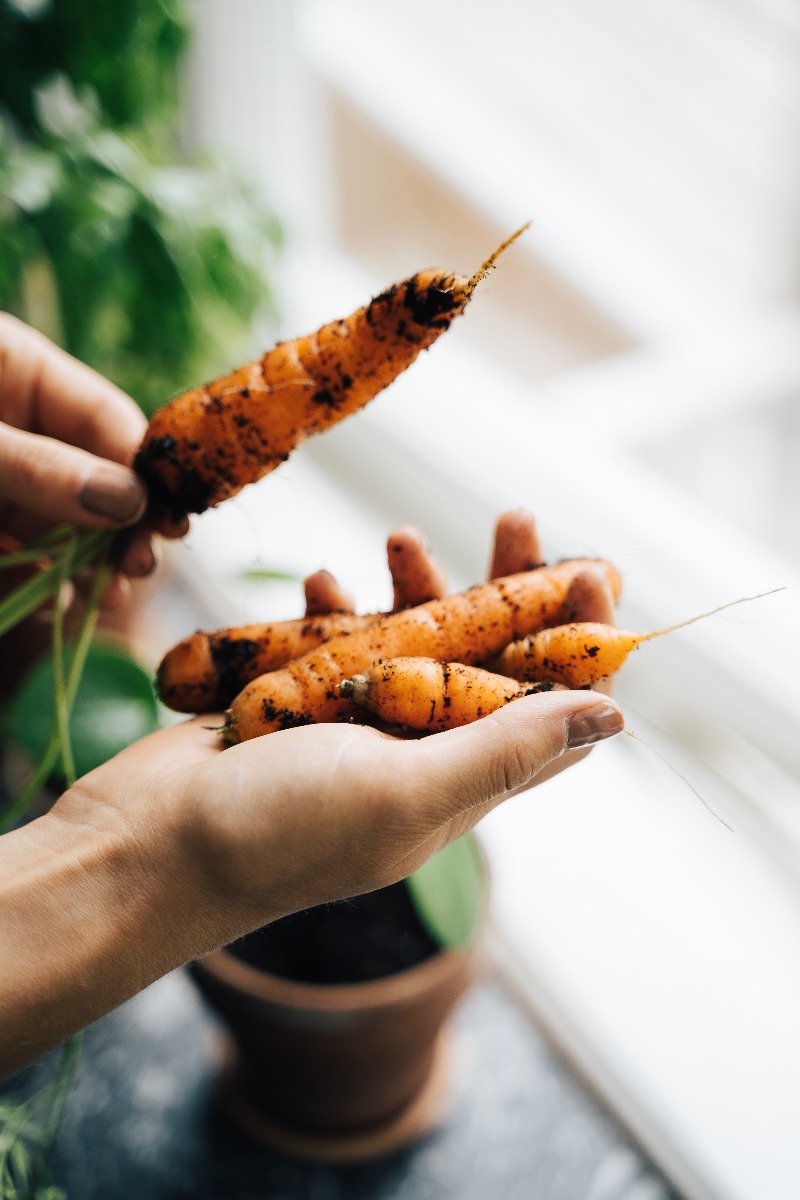
Over the years, however, these same vegetables have taken me on a journey of discovery about the food we eat. I now look at them in a completely new light. I love the fact that my food comes with the soil still attached to it. This reminds me that my food does not come from a plastic bag, but from the ground. Scrubbing the soil off my carrots gives me contact with the earth that produced it and reminds me of the labour that went into growing it (though I confess I don’t particularly enjoy finding slugs in my vegetable drawer!).
I now love the fact that the vegetables come in seasons. Again, it brings me back into contact with nature, away from the bright lights and plastic bags of the supermarkets. It teaches me that things have their seasons – a very biblical idea – and helps me to appreciate the rhythm that is in life (Psalm 1:3; Ecclesiastes 3:1–8). There is no doubt, too, that many vegetables grown and harvested in season taste far better than the vegetables I used to buy, and so waiting brings a greater appreciation for them.
I have also grown to love my vegetables coming in all different shapes and sizes with their lumps and bumps. I now positively dislike having to buy vegetables in the supermarket: the rows of perfectly shaped and identically sized produce depress me. How did they get like that anyway?
One answer is that anything that does not meet the industry or supermarket standards regarding length, size, lack of blemishes and so on is thrown away. The other answer is that vegetables and fruit are produced like that through the use of chemicals: insecticides, herbicides and pesticides. Over 17,800 tonnes of pesticides were applied to UK crops in 2015 and, altogether, 300 different pesticides are permitted for use in non-organic farming. (This contrasts with only twenty pesticides allowed under organic farming standards, derived from natural ingredients and only used in very restricted circumstances.) For example, an average of thirty-three pesticides are used on UK orchard crops (apples, pears, plums and cherries), which are sprayed seventeen times. Many of these pesticides are systemic, which means they permeate into the flesh of the fruit, and so cannot be removed through peeling or washing. According to Pesticide Action Network UK, approximately 60% of British non-organic fruit and vegetables contains pesticides. Many of these contain residues of multiple pesticides. If all farming were organic, the amount of pesticides used would decrease by 98%.
Bringing up children has turned many people, including me, towards organic food.1 Although overall organic food accounts for only 1.5% of total food and drink sales in the UK, and 4% of food and drink sales in the US, since writing this book I have seen it go from fringe and somewhat weird to mainstream. In both the UK and the US, organic food and drink sales are growing by over 6% each year, faster than non- organic sales, and 2017 saw UK home delivery of organic produce (i.e. from box schemes) grow by 10.5%.
The damage being done to the environment and to biodiversity is only too evident when you look at the difference in wildlife on organic and intensive farms. Research has found that plant, animal and insect life is more abundant on organic farms, which are home to 30% more species. Some endangered species on farmland were found only on organic farms. There were 44% more birds in fields outside the breeding season, and again endangered birds such as the song thrush were significantly more numerous on organic farms. In particular, there were more than twice as many breeding skylarks.
Intensive farming has been happening for only the past seventy years – the post-war period when, understandably, rationing caused by a loss of food imports led the government to produce a new food policy that would encourage maximum production. The consumer’s constant desire for cheap food has encouraged this to continue, so that since the 1950s we have seen a huge increase in production, while prices have fallen. The way that our world has developed since then has allowed us to import whatever we want, whenever we want. This has benefited us with cheap food all year round and an endless variety of products – and a proliferation of TV shows and competitions to match!
We are now beginning to realize, however, that cheap food is coming at a heavy cost. Apart from the effects of intensive farming on the environment and on biodiversity, there is also the effect of the transport and packaging involved. It is thought that 75% of the cost of food is in its processing, packaging and distribution. We often hear now about the issue of ‘food miles’, and it is a sobering fact that food accounts for 23% of freight moved by UK heavy-goods vehicles, more than any other commodity.
Then there are the implications for our health: many of us will hardly need reminding of salmonella, BSE, foot-and- mouth disease and bird flu. Moving away from the negative, though, there are thought to be positive benefits in eating organic foods. Research carried out since the first edition of this book now shows that no other food has higher amounts of beneficial minerals, essential amino acids and vitamins than organic food. For example, according to research conducted by European scientists, organic milk has nearly 56% more essential fatty acid omega-3 than its non-organic equivalent, and research in the British Journal of Nutrition found increased concentrations of anti-oxidants and other beneficial compounds in organic food.
The welfare of farmed animals is also extremely important. Thanks to factory farming, the meat that was most expensive when my parents were children (chicken), and the fish that was most expensive when I was a child (salmon) are now among the cheapest that can be bought. When you look at the conditions in which both are produced, however, you understand why. Instead of describing the life of a battery chicken, let me quote the wonderful chef, Hugh Fearnley- Whittingstall, who says that anyone who buys such meat is ‘either an idiot or a heartless bastard’. The same conditions apply to the salmon that is now available, so I try not to eat salmon unless it is from an organic farm or MSC-certified (see further, ‘K is for Kippers’).
These issues have been publicized much more since I first wrote this book. In 2008 British chefs Hugh Fearnley- Whittingstall and Jamie Oliver were at the forefront of a highly publicized campaign to stop consumers buying intensively farmed chickens. At the time the campaign seemed to be working, as demand for higher-welfare chicken rocketed. However, all these years on, it is noticeable that we haven’t sustained this move, and so supermarkets are now stocking less higher-welfare meat and more factory farmed (Waitrose being a positive exception in this regard). Sadly, little has changed to ensure good welfare standards for chickens and other animals. My own little adventures in keeping laying hens and rearing pigs and chickens for meat have only served to heighten my appreciation for these issues (and shown me that there really is a huge difference in the quality of the meat produced). It is crucial that, as Christians, we only use our money to support those who look after the animals that we will eat. After all, as Proverbs in the Old Testament wisdom literature says, ‘The righteous care for the needs of their animals’ (12:10).
 As poet and environmental activist Wendell Berry says, how and what we eat is a political issue – an issue of freedom:
There is a politics of food that, like any politics, involves our freedom. We still (sometimes) remember that we cannot be free if our minds and voices are controlled by someone else. But we have neglected to understand that we cannot be free if our food and our sources are controlled by someone else. The condition of the passive consumer of food is not a democratic condition. One reason to eat responsibly is to eat free.
Our attitude to food is influenced by other aspects of our lives. The chapter ‘S is for Simplicity’ shows how our use of time reflects our values and affects many areas of our lives. This is no less true with regard to food. Biblically, food is a part of the gift relationship that God established with humanity in the Garden of Eden. We see there the goodness of food as a gift from God to sustain us. This is reflected in the way we use food as a central part of our relationship building. Our demand for convenience, as seen already in ‘D is for Driving’, threatens to erode the relational aspect of food, as well as contributing to the mounting problem of food waste (see action point below).
There is thus a spiritual side to food. See how often the Bible links food and eating with central biblical concepts (Communion, the water of life, fasting, ‘taste and see that the Lord is good’, the eschatological banquet, and so on). Author and Christian environmentalist Michael Schut views food as a sacrament, and talks of ‘the spirituality embodied in our personal and cultural relationship to food’. I see the food I eat and the way I produce it as one of the ways in which I worship God; eating and producing in a manner that respects what he has created, both human and non-human. As Christians we must do no less.
Action points
- Buy seasonal, local, organic food, and reduce your reliance on supermarkets (but see ‘Q is for Questions’ for a more detailed discussion). Farm shops, delivery boxes and farmers’ markets are great ways to do this. (The Soil Association provides information on these.) Get together with friends to form a food cooperative, enabling you to buy organic and Fairtrade food at wholesale prices (see e.g. Infinity Foods). If you have to choose, go local rather than organic, but try to do both! Green Christian has devised a useful mnemonic – just follow the LOAF principle: Local, Organic, Animal friendly and Fairly traded.
- Grow (and rear!) your own food. Whether you have an allotment or just a windowsill, you can grow some of your own things, making the connection between your food and the land. You will know exactly what has gone into it, and the food miles will be zero.
- Question your supermarket constantly (contact Friends of the Earth’s ‘What to Eat’ food campaign, and see ‘B is for Bananas’ for more on Fairtrade). Let them know what you would like their policies to be. (‘L is for Letters’ looks further at this.) If you use different supermarkets, compare their answers.
- Shop wisely and only buy what you will eat. A third of food is currently thrown away by wealthy consumers, contributing to climate change which is increasing world poverty and hunger. (For more on how to reduce food waste, see Tearfund’s Renew Our Food campaign and Wrap UK)
Related Posts
Categories
Recent Posts
1
Explore Our March New Releases
17 Mar 2025
2
Counter-rituals for the Christian creative
24 Oct 2024
5
NSBT New North American Publisher FAQ
14 Oct 2024
Support IVP with your donation
Either donate with a one-off donation or subscribe monthly.
Choose a type of donation
I want to donate
 I want to donate