



 I want to donate
Guest Blog Post: Why the Church Needs Reformation and Revival
- Laura Barry
- General
- 31 Oct 2022
-
155views
When the church is in a time of decline it needs to walk on two legs - one is reformation and the other is revival, and both are necessary.
When I was converted in the 1980’s, my church was heavily influenced by Dr Martyn Lloyd-Jones. He was pastor of Westminster Chapel in London and a light for the evangelical church through much of the twentieth century. Lloyd-Jones often spoke and wrote about the history of revivals and the need for another to occur in our day. They were the beacon of hope for our hour, and we prayed for something like that to happen again. However, because we could do nothing but wait for a revival it tended to turn into a passivism where we wrung our hands in despair at how awful everything was. It felt like a scene from Samuel Beckett’s play Waiting for Godot where the two main characters are told to wait by a tree for Godot to show up. What is not clear is when and how Godot will do that.
After some years in these circles, reading Francis Schaeffer (the pastor, philosopher and apologist best known for starting L’Abri Fellowship in Switzerland) was a game changer for me. Through him I discovered a reformation tradition that combines the historic faith and the modern world. Matters such as education, politics, psychology, the arts and a Christian philosophical viewpoint, widened the scope of Christ’s Lordship as something to work for. Engaging this new reformational heritage, I inadvertently left my revival roots behind. Recently, I have embraced them again.
Given the present state of the church, revival is a necessity. But that does not mean we just sit and wait. We still have work to do – and that is what reformation is for.
A reforming church
Reformation is what the church does to put its own affairs in order. I like to think of this as rubble removal, and this rubble will look different depending on time and place. Back in Old Testament times the rubble tended to be the idols. In the sixteenth century, it existed as political and economic corruption inside the Catholic Church. It had an infrastructure that made those at the top fabulously rich. Often the position of a bishop or a cardinal went to the highest bidder. This wealth was at the expense of the poor who were terribly exploited. One way they were manipulated was through the selling of indulgences. The initial part of Luther’s reform was to clear out this rubble. He did this by exposing how ungodly such practices were.
Protestants sometimes believe that this has been the only reformation in our history. However, the great reformers of that time were clear that reformation was something the church should constantly engage in. They coined the term semper reformanda, which is Latin for ‘the church must always be reformed’. There have been many reformations, and each is a tale of how a few turned the church upside down.
If reformation is rubble removal then the church today needs to know what has gone wrong. What has been deformed by our secular age needs reforming and that means discerning the problems. Thankfully, the Lord has gifted his church with people who have done excellent work in diagnosis. Over the past hundred years, there have been modern-day prophets who understand the times. People like G. K. Chesterton, Dorothy L. Sayers, C. S. Lewis, Francis Schaeffer, Os Guinness and others have done the hard work – to name but a few. With their help, the church can be equipped to take a look at ourselves and see what is wrong and what reformation will require.
A revived church
However, in a time of decline the malaise can be so great that the church cannot simply reform its way out of it. We require revival as the dramatic intervention of the Triune God to revitalize his church. When revivals occur, no one doubts that the Holy Spirit is working. These come with a divine power that is irresistible. You can think of revival as the equivalent of a ‘mouth-to-mouth’ resuscitation – Christ coming to the rescue to breathe life into his bride who has stopped breathing and is acutely ill. This is not something we can do for ourselves. If you have collapsed in a fast-food outlet with a terrible pain in your chest, you cannot do CPR on yourself. You need someone to come to your rescue, someone who knows what they’re doing – thirty chest compressions followed by two rescue breaths into your airways. Christ does this for his church through a special operation of his Spirit.
Looking back on the history of the church, we see the effects of revivals. At moments when the church was in terrible decay, great reversals happened. And that’s what revival is – a great reversal. There is no formula for revival, and the church cannot manufacture it. It is enough to know that Christ did something dramatic – at the right time and in the right way. When revivals have occurred, they have made all the difference. And whenever revivals have happened, there have been decisive benefits to nations and cultures. When the church is revitalized, there is an overflow to the world. With Christ’s glory and weight in his church, it could not be otherwise.
If my diagnosis is correct, then I believe we have reached such a moment – we need divine resuscitation. Because revivals are beyond our strategies and techniques, all we can do is cry out to the Lord for one. And revival will make no sense to us unless we see our need of it. To acknowledge that we need reviving is to admit something is amiss. We must become revival-conscious. Then we know that reformation without revival is not enough because it leaves the matter of resuscitation in our hands. We need both!
And so the church must become two-legged. As we reform, we do this with a profound revival consciousness. That means us doing our part even as we look to Christ and his Spirit to do his.
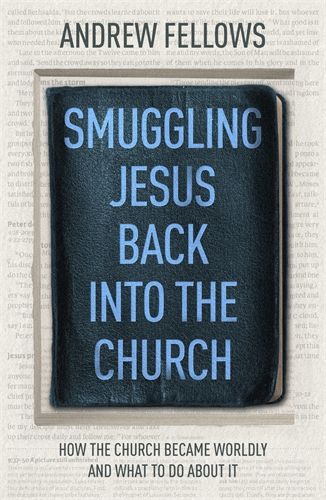
To read more of Andrew Fellow's inspiring reflections take a look at Smuggling Jesus Back into the Church, available in paperback and ebook here.
Smuggling Jesus Back into the ChurchHow the church became worldly and what to do about itBy Andrew FellowsA polemical but hope-filled guide from Andrew Fellows that explores how Jesus has been forgotten in the modern church – and how we can put him back at its heart Andrew Fellows shows us with a sharp eye how secularism has reshaped church culture, changing the way many Christians and churches live and worship without being noticed. Both provocative and practical, he challenges us to live with radical Christ-like distinctiveness - distinctiveness that requires both reformation by the church and revival by the Holy Spirit. Timely and prophetic, Smuggling Jesus Back into Church is essential reading for anyone concerned about the effects of secularism on Christianity and modern church culture, or for anyone who struggles with Church and wants to understand why. Filled with passion and vision, it will point you back towards Jesus and revitalise your understanding of what Christian discipleship should be. |
 BUY HERE BUY HERE |
Related Posts


Related Products

Rediscovering Joy
From £7.99

Celebrating the Reformation
From £24.99

The Unquenchable Flame
From £9.99

More Truth
From £8.99

A Call to Spiritual Reformation
From £16.99

Smuggling Jesus Back into the Church
From £11.99
Categories
Recent Posts
1
Explore Our March New Releases
17 Mar 2025
2

Counter-rituals for the Christian creative
24 Oct 2024
5
NSBT New North American Publisher FAQ
14 Oct 2024
Support IVP with your donation
Either donate with a one-off donation or subscribe monthly.
Choose a type of donation
I want to donate
 I want to donate