


 I want to donate
What should Christians learn about leadership from Boris Johnson’s ‘partygate’?
- Laura Barry
- New Releases
- 3 Mar 2022
-
26views
What should Christians learn about leadership from Boris Johnson’s ‘partygate’?
It’s now all been rather overshadowed by events in Ukraine, but remember the fuss of the moment a couple of weeks ago? Whether you’re a Conservative party supporter or staunch opponent of the Tories, Boris Johnson’s continued attempts to downplay lockdown parties in Number 10 struck most voters as a low point for political leadership.
It’s in sharp contrast to the courage in leadership shown by the President of Ukraine, Volodymyr Zelenskyy, who rather than fleeing the country for the safety of government-in-exile, told the Americans ‘I need ammunition, not a ride’, and who has stayed to fight for his country against the Russian invasion. It’s all the more surprising given his background as an actor and comedian, making him an unlikely Churchill. Perhaps Boris would rise to the occasion with similar surprising fortitude if the country was on the brink of invasion. But his premiership has instead been put to the test by birthday cake.
Whether you’re a Conservative party supporter or staunch opponent of the Tories, Boris Johnson’s continued attempts to downplay lockdown parties in Number 10 have struck most voters as a low point for political leadership.
The interim update from Sue Gray published on 31st January didn’t go into specifics due to the ongoing police investigation by the Met. But it nonetheless criticised “failures of leadership and judgement” surrounding the 16 events under investigation.
We all have our own stories of the sacrifices made for lockdown. For me, the hardest moment was my grandmother’s funeral in April 2020, where only a small handful of close family were allowed to gather to mourn, socially distanced and prevented from sharing grief and comfort with a hug.
After the Government imposed such strict lockdown rules on the country to curb the spread of Covid, it’s unsurprising that reports of parties in Downing Street have become a lightning rod for people’s anger and grief. It’s been worsened by reluctance to come clean and apologise, with carefully worded “sorry if you were offended” non-apologies coming only after the drip drip of revelations became unavoidable.
But are we in the church in danger of being more like Boris and his defenders than we dare to admit?
The unbridled pursuit of ‘success’
I’m not here to put the boot into Boris, as easy a target as he is right now, or get into whether the seeming disparity between his behaviour and his government’s own Covid rules amounts to a resigning matter.
Rather, I think we need to be careful as the church to examine ourselves, and particularly how we behave either as leaders ourselves or in defending our leaders if they are accused of wrongdoing.
Just as many of the Conservative Parliamentary Party faithful have (so far) circled the wagons, defending Johnson for “getting things done” whatever his personal peccadillos may have been, so too the evangelical church has an unhealthy habit of excusing bad behaviour where powerful leaders have a “fruitful ministry”.
Whether it’s politicians trying to stop the spread of Covid or Christian leaders seeking to speed the spread of the Gospel, we are in grave danger when we start acting as if the end justifies the means. As The Rise and Fall of Mars Hill podcast has recently so vividly illustrated, if a ministry is outwardly successful, with growth and good ‘numbers’, there seems to be almost no end to the bullying and abusive behaviour that we will turn a blind eye to – until it becomes undeniable and the knives come quickly out and history gets rewritten to distance ourselves from any possible complicity.
Understanding the slippery slope
They say that the ‘road to hell is paved with good intentions’. But how exactly does a well-meaning leader end up misusing or abusing their power and authority, whether through flouting rules that they have set for others, or using power for their own status and satisfaction rather than the good of others?
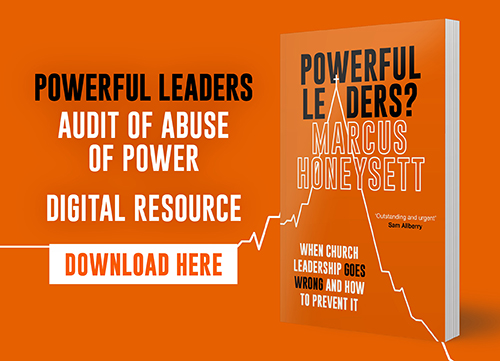
Marcus Honeysett’s new book Powerful Leaders? Where Church Leadership Goes Wrong and How to Prevent It, out this month from IVP, attempts to put up some warning signs at the top of the slippery slope, so that church leaders and those around them can prevent any slide towards unhealthy or abusive leadership before it becomes irreversible. It looks at how we should listen to victims, and make sure we are seeking truth and justice when complaints are raised.
The misuse of power can begin not out of self-serving aims, but from a desire to get things done for the cause of the Gospel. A few forceful words here to get the flock more committed, a bit of guilt manipulation there to keep people in line, some bypassing of ‘red tape’ of accountable processes and procedures – all for the best reasons!
But as Jesus warns, a bad tree cannot bear good fruit. We need gospel culture as well as gospel aims. And when the use of power has become illegitimate for other-serving or mission-serving aims, it is a very small step to start misusing power for self-interested reasons – especially if we make the mistake of equating our outward success as leaders with the success of the Kingdom.
Waiting for Sue Gray
As we wait for the outcome of the Met investigation and the full publication Sue Gray’s report to bring ‘Partygate’ to some kind of closure, we do to remember that as the church we have a much higher responsibility to the highest authority.
God sees our leadership, both what’s done in public and what’s done in private, and every Christian leader will give a full account. There is grace and forgiveness at the Cross for the truly repentant, of course, but we must beware ‘cheap grace’ that defends abusers and sidelines victims.
Each situation is complex, and there are many more reasons that church cultures can become unhealthy or abusive, and individuals make the fateful choices to cross the lines of proper integrity, goodness, accountability and transparency. Powerful Leaders? explores many of them, but there is much more for us as the church to reckon with and work through.
My prayer as editor is that Powerful Leaders? will play some small part in equipping us to better seek to pursue Christ-like, sacrificial leadership, and the church cultures, policies and procedures that promote and protect healthy leadership.
Download Your Free Resource HERE.
Related Posts

Related Products

Powerful Leaders?
From £9.99
Categories
Recent Posts
1
Explore Our March New Releases
17 Mar 2025
2

Counter-rituals for the Christian creative
24 Oct 2024
5
NSBT New North American Publisher FAQ
14 Oct 2024
Support IVP with your donation
Either donate with a one-off donation or subscribe monthly.
Choose a type of donation
I want to donate
 I want to donate